




Learn how to play Handpan
Your gentle path into the world of the handpan, guided by Malte Marten and the community behind YataoShop.
The handpan is one of the most intuitive and welcoming instruments in the world. You do not need any musical background. You do not need to read music. You do not need years of preparation before you can play something beautiful. In fact, most people who pick up a handpan for the first time can play a simple, calming melody within the first ten minutes.
At YataoShop, we've spent years walking beside beginners, intermediate players, and lifelong musicians on their handpan journey. Together with Malte Marten and the entire Malte Marten Method community, we've built a path that meets you exactly where you are and gently guides you forward. This page is your starting point.
Is the handpan easy to learn? Yes. The handpan is designed so that every note within its scale sounds harmonious. There are no wrong notes. After about 20 to 30 minutes of learning the basic touch technique, you can begin playing intuitively and creating your own melodies.
Why Learning the Handpan Feels Different
Many instruments demand that you learn theory before you can express yourself. The handpan works the other way around. Its pentatonic scale layout means that whatever you play will sound harmonious. This creates a rare gift for beginners: the freedom to explore without fear of playing something wrong.
This is why so many people describe their first encounter with the handpan as emotional. The sound seems to invite you inward. It slows your breathing. It creates space for meditation, for creativity, for connection. And it does all of this from your very first note.
Our approach at YataoShop reflects this special quality. We believe that learning the handpan should feel like a natural unfolding, not a series of hurdles. That is why every course, every workshop, and every conversation we have with students starts from the same principle: honesty, care, and genuine musical experience.
Meet Malte Marten and the Malte Marten Method
Malte Marten is one of the most respected voices in the international handpan community. His journey began in 2014, when he heard the sound of a handpan for the first time and simply followed that feeling. Over the years, he has taught more than 10,000 students, performed for audiences around the world, and developed his own pedagogical approach: the Malte Marten Method.
The Malte Marten Method is not a set of rigid rules. In Malte's own words: "I teach from experience, not from rules. My approach is hands-on, heart-open, and free of pressure." It is built to guide students from level 1 to level 10 without ever losing the joy of playing.
The Malte Marten Method is built on three pillars: Flow, Authenticity, and Experience. It offers a practical path to becoming more skilled, confident, and effective in playing the handpan.
The Three Pillars of the Malte Marten Method
Flow
Learning should feel natural, playful, and alive. Every exercise is undertaken with a spirit of exploration, so that new patterns and rhythms integrate into your playing without ever breaking your joy.
Authenticity
Your musical voice is already inside you. This journey is not about imitating someone else. It is about honoring your unique expression and helping it come through your instrument.
Experience
You learn the handpan by playing, not just by watching. Every lesson invites hands-on exploration, deep listening, and personal growth alongside technical development.
Start Free: The Handpan Mini Class
The best way to begin is with something completely free. The Malte Marten Method Free Mini Class gives you a real taste of how learning with Malte feels, without any commitment.
Inside the Free Mini Class you'll receive:
- Seven exclusive video lessons plus one bonus video
- A comprehensive mini eBook available in multiple languages
- Deep insight into Malte's teaching approach and philosophy
- A guided play-along session so you can feel the joy of playing right away
- Access to the Malte Marten Method community
- A special discount code for YataoShop upon completion
You do not need any prior experience. You do not need to already own a handpan. You just need curiosity, and about an hour of quiet time.
Your Learning Journey: What to Expect
Every student progresses at their own pace. But there is a natural arc that most players follow, and understanding it helps you know what to focus on now, and what will come later.
Stage 1: Your First Sound (Day 1 to Week 1)
You learn how to sit comfortably with your handpan, how to strike the notes with your fingertips, and how to breathe with the music. Within your first hour you can already play a simple two-note alternation. Within a week, most students can play a small melody they've created themselves.
What you'll focus on:
- Correct posture and how the handpan rests on your legs
- The basic touch technique using fingertips, not nails or palms
- Finding the Ding, the central note
- Playing individual tone fields cleanly
- The relationship between breath and rhythm
Stage 2: Building Foundations (Weeks 2 to 8)
You learn to coordinate both hands, discover hand-to-hand patterns, and build your first simple grooves. This is the stage where the instrument begins to feel like an extension of you rather than something outside of you.
What you'll focus on:
- Hand-to-hand basics, ping-pong and zig-zag patterns
- Playing along with backing tracks
- Chord progressions and how tones relate to each other
- Simple grooves and consistent rhythmic feel
- Short daily practice sessions of 15 to 20 minutes
Stage 3: First Musical Expression (Months 2 to 4)
You start to improvise. You compose your first pieces. You discover your own musical voice. Most students say this is the stage where the handpan truly becomes theirs.
What you'll focus on:
- Improvising simple melodies without thinking
- Trance grooves and arpeggio patterns
- Understanding dynamics and intentional playing
- Building your first personal compositions
Stage 4: Intermediate Development (Months 4 to 12)
You begin to add expressive techniques that give your playing texture, color, and depth. This is where the handpan reveals its true range.
What you'll focus on:
- Advanced techniques: ghost notes, slaps, mutes, harmonics, WhaWha, The Wave
- Cross-hand playing and alternating left-hand patterns
- Polyrhythms and halftime rhythms
- Playing with others and jamming in community
- Refining your unique musical voice
Stage 5: Advanced Mastery and Beyond (Year 1+)
You develop complex polyrhythms, split-hand technique, dynamic control across the full range of soft to powerful playing, and deep emotional composition. Some students at this stage begin teaching others through the Malte Marten Method Teacher Training.
Choose Your Path: Online Courses by the Malte Marten Method
The Malte Marten Method offers four learning paths, each designed for a different stage of your journey. All courses include lifetime access, mobile viewing, and integration into the Malte Marten Method community.
Free Mini Class
Free
7 video lessons + eBook. Your first taste of the Malte Marten Method. No prior experience needed.
Beginner Journey
€89
12-week guided program with 16 tutorial videos. A clear, simple path to start playing with confidence.
D Kurd Scale Course
€149
Dedicated to the D Kurd scale. Works with all D Kurd handpans (9 to 13 notes). Includes eBook.
Handpan Fundamentals
€449
The most comprehensive handpan course online. 150+ video lessons, 100+ patterns, tablature eBook, software, and community. 14-day money-back guarantee.
Course Comparison at a Glance
| Course | Price | Level | Best For |
|---|---|---|---|
| Free Mini Class | Free | Absolute beginner | Trying out the method with zero commitment |
| Beginner Journey | €89 | Beginner & Beginner+ | A structured 12-week start with fair pricing |
| D Kurd Scale Course | €149 | Beginner | Focused study of the world's most popular scale |
| Handpan Fundamentals | €449 | Beginner to Intermediate | 10 years of experience distilled into one course |
Handpan and Course Bundles: Everything in One Purchase
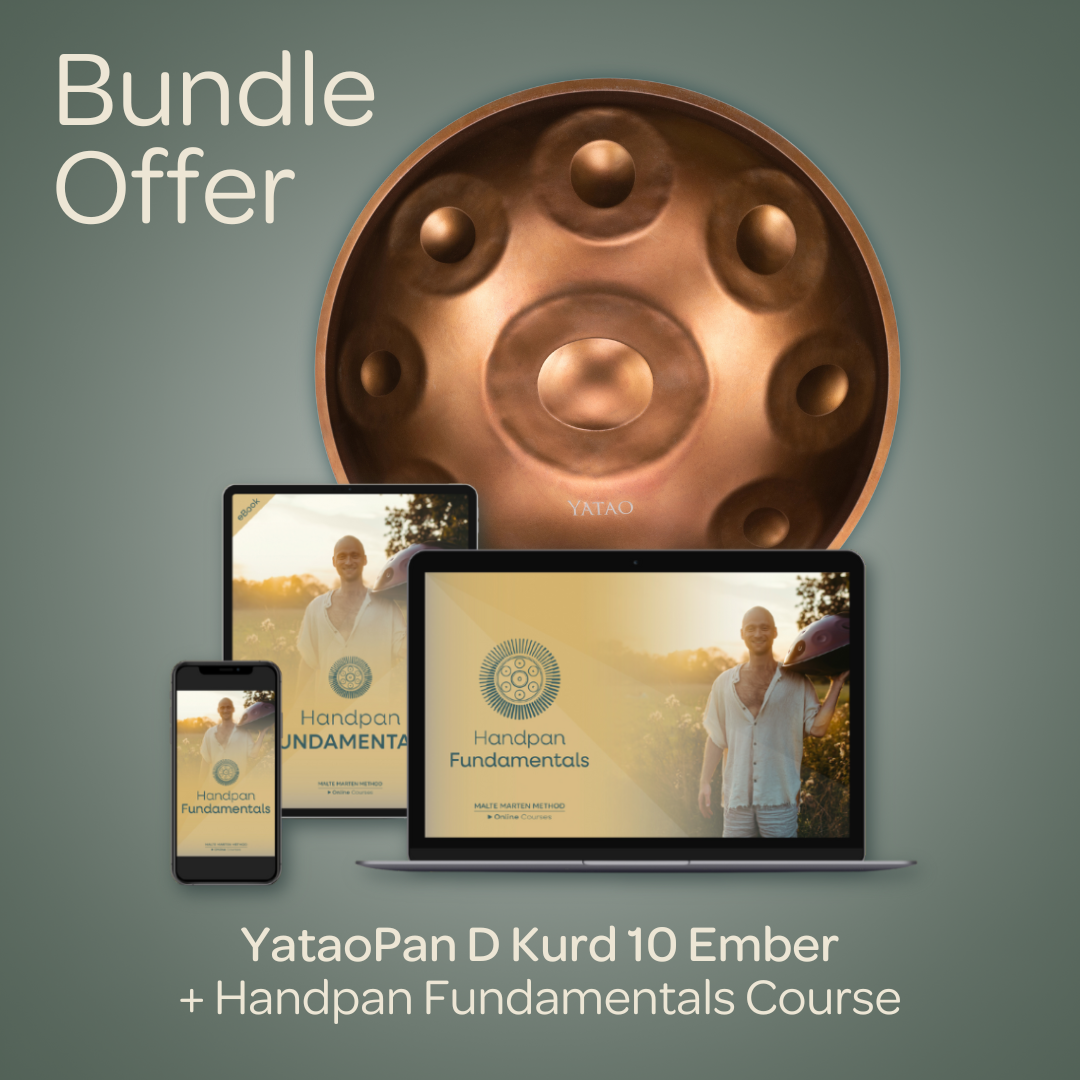
One of the questions we hear most often is: "Which handpan should I buy, and which course should I start with?" To make this decision easier, we created bundles that pair carefully selected Yataopan handpans with the online courses that best suit them.
Every bundle is built around the idea that your instrument and your learning should belong together from day one.
D Kurd 13 + D Kurd Scale Course
The classic starter combination. Our flagship Yataopan D Kurd 13 handpan paired with the dedicated D Kurd Scale Course. Everything you need to begin playing beautifully.
D Kurd 13 + Handpan Fundamentals
For students who want the complete learning journey from day one. Our Yataopan D Kurd 13 paired with the 150+ video Handpan Fundamentals Course.
All Handpan Bundles
Browse our complete collection of handpan and course bundles across multiple scales and learning depths.
Find a Handpan Teacher Near You: The MMM Teacher Map
Learning online is powerful, but nothing quite compares to sitting with a teacher in the same room. That's why the Malte Marten Method built something no other handpan school in the world offers: a global network of certified teachers, mapped by city.
The MMM Teacher Map connects you with certified Malte Marten Method teachers across Germany, Switzerland, the UK, USA, Canada, France, Italy, Japan, Vietnam, the Netherlands, and China. Every teacher on the map has been personally trained and certified, so you know exactly what to expect from your first lesson.
Whether you want a single trial lesson, a regular weekly practice, or a small group class, the Teacher Map is often the fastest way to find in-person guidance.
Or Visit One of Our Showrooms
If you prefer to try a handpan in person before you decide on a teacher or an instrument, you're warmly invited to visit one of our partner Showrooms. You'll be able to hear the difference between scales, feel the instruments in your own hands, and speak with people who love what they do.
Live Workshops and the Handpan Retreat 2026
There are moments in learning that can only happen in the same room as your teacher and fellow students. Live workshops and retreats offer this kind of experience: immersive, transformative, and impossible to replicate online.
Handpan Retreat 2026 at Schloss Elmau
Once a year, Malte Marten hosts a fully immersive retreat in one of the most breathtaking places in the Bavarian Alps. The Handpan Retreat 2026 takes place from December 6 to 11, 2026 at Schloss Elmau, roughly two hours from Munich and forty minutes from Innsbruck.
Over five deeply nourishing days, you'll dive into daily handpan sessions with Malte, explore the beauty of the Alps, enjoy spa and wellness time, and share meals with a small group of like-minded players. Every participant receives a rental E Amara 20 handpan for the full retreat.
The retreat is designed for Beginner Plus and Intermediate players who want to slow down, reconnect, and truly deepen their musical journey. It's held in English, so it's accessible to international students from around the world.
Each day covers a different aspect of playing:
- Grooves and rhythms: finding flow and ease
- Patterns and structure: how melodies and rhythms connect
- Expression: bringing emotion and personality into your playing
- Improvisation and composition: exploring your own musical ideas
- Jamming and playing together: the joy of group music
- Stroke techniques: refining your touch and sound
Discover the Handpan Retreat 2026 →
Workshops and Tours
Throughout the year, Malte hosts workshops across Germany and Europe. Past tours have included Berlin, Hamburg, Cologne, Munich, Stuttgart, and Mainz, with sessions for both beginner and intermediate players. Handpans are provided during workshops, so anyone can join.
To be the first to hear about upcoming workshops, visit the Workshops page or subscribe to Malte's newsletter directly on his site.
Choosing Your First Handpan
The instrument you begin with shapes your entire learning experience. That's why we take the recommendation of your first handpan so seriously.
For most beginners, we recommend the D Kurd scale. It is the most popular handpan scale in the world for good reason. Its notes are emotionally warm, immediately playable, and versatile enough to accompany you through years of musical growth. Our own Yataopan D Kurd 13 was designed specifically as an accessible, beautifully tuned entry point.
Other paths for beginners include exploring the full Beginner Handpans Collection or the wider Yataopan Collection. If you're feeling unsure, we've built a simple guided consultation to help you decide:
If you'd like to understand more about scales, tuning, and how a handpan is built before you choose, our detailed guide covers everything you need to know: Handpan Scales and Theory.
And if you want a deeper look at what actually separates a great handpan from a mediocre one, our guide on The Most Important Criteria When Buying a Handpan walks you through it honestly.
Techniques You'll Learn Along the Way
Handpan playing has a vocabulary all its own. Here are some of the techniques you'll come to know as you progress through the Malte Marten Method:
- The Ding: The central note of the handpan, often the deepest and most resonant. Learning to strike the Ding cleanly is one of your very first steps.
- Ghost notes: Very soft touches that add texture without being fully heard as notes. They create rhythm inside the space between notes.
- Slaps and Mutes: Percussive touches that give your playing rhythmic drive and dynamic contrast.
- Harmonics: Delicate high overtones that emerge when you strike specific spots of the tone field with the right pressure.
- The WhaWha: A signature Malte Marten technique that creates a vocal, singing quality inside your playing.
- The Wave: A flowing pattern that rolls across the notes with a smooth, wave-like feel.
- Trance Groove: A repetitive, meditative pattern that puts both you and your listener into a flow state.
- Polyrhythms and Halftime Rhythms: Advanced rhythmic layering that adds musical depth and complexity to your compositions.
- Cross-hand playing: Playing across the tone field with alternating hands in unexpected ways, opening up entirely new musical possibilities.
Every one of these techniques is covered in depth inside the Handpan Fundamentals Course, with clear video demonstrations, patterns to practice, and tablature you can download for offline study.
How Much Should You Practice?
The honest answer is: less than you probably think. Most students see wonderful progress with just 15 to 20 minutes of focused daily practice. Consistency matters far more than duration.
A practice session might look like this:
- Two minutes of tuning in: Sitting quietly with your handpan, breathing, and listening.
- Five minutes of technique: Working on a specific stroke, pattern, or exercise from your course.
- Five to eight minutes of free play: Improvising, exploring, and letting the sound move you.
- Two minutes of closing: Playing something you love, without any goal, just to end in joy.
You don't have to practice every day. But playing four or five times a week, even for just a short time, will bring you further than a single long session on the weekend.
Our Values: Why We Teach This Way
YataoShop and the Malte Marten Method share the same foundation. We believe learning the handpan should be honest, welcoming, and deeply personal. Here's what that means in practice:
Honesty
We tell you the truth about handpans, scales, prices, and what learning will actually feel like. We built a full blog of honest handpan guides so you can decide with full information, not with sales pressure.
Care
Every student is met individually. Malte's teaching philosophy is grounded in care: "For me, it's essential that beginners taking their first steps into the handpan world are guided thoughtfully and effectively." Every course includes access to a supportive community and direct feedback channels.
Community
Learning alone is possible. Learning together is transformative. The Malte Marten Method Community, the MMM Teacher Map, and the annual retreats all exist because we believe the handpan naturally connects people.
Accessibility
High-quality handpans and world-class teaching should not be reserved for the few. That's why the Free Mini Class exists. That's why the Beginner Journey is priced at €89. That's why our bundles pair beautiful instruments with courses at fair prices.
Ready to Begin?
Wherever you are in your handpan journey, we're here to walk beside you. Here are the three simplest ways to take your next step today:
1. Start Free
Take the Malte Marten Method Free Mini Class and get 7 videos, an eBook, and a taste of how learning with Malte feels.
2. Find a Teacher
Browse the MMM Teacher Map to find a certified Malte Marten Method teacher near you, on four continents.
3. Choose Your Handpan
Take our guided consultation and let us help you find the instrument that feels right for you.
Your journey doesn't have to begin perfectly. It simply has to begin with the very first sound.
Frequently Asked Questions
Is the handpan hard to learn?
No. The handpan is one of the easiest instruments in the world to begin with. Every note within its scale sounds harmonious, so you cannot really play wrong notes. After about 20 to 30 minutes of learning the basic touch technique, you can begin playing intuitively and creating simple melodies. Deep mastery, like with any instrument, takes years, but the joy of playing arrives almost immediately.
Can I learn the handpan without any musical experience?
Absolutely. The Malte Marten Method is specifically designed for complete beginners with no prior musical background. You do not need to have played another instrument. You do not need to read music. Many of our students describe themselves as "unmusical" before they started, and are now improvising freely.
Do I need to read music to play the handpan?
No. Traditional sheet music is not used for handpan learning. The Malte Marten Method uses clear visual tablature, video demonstrations from multiple camera angles, and intuitive play-along practice. You'll learn by watching, listening, feeling, and playing.
How long does it take to learn the handpan?
You can play your first simple melody within about 10 minutes. Two-handed coordination usually settles within your first week. After around three months of regular practice, most students can improvise short melodies without thinking. Reaching an intermediate level typically takes 6 to 12 months, and mastery is a lifelong journey. The Malte Marten Method's structured 12-week programs are designed to make this arc feel natural.
What handpan should I buy as a beginner?
For most beginners, we recommend a handpan in the D Kurd scale with 9 to 13 notes. It is the most popular scale in the world because it sounds beautiful immediately and offers enough depth to grow with you. Our Yataopan D Kurd 13 was designed specifically as an accessible, high-quality first instrument. If you'd like personal guidance, use our Find Your Perfect Handpan consultation.
What is the Malte Marten Method?
The Malte Marten Method is a pedagogical approach to teaching the handpan developed by Malte Marten. It is built on three pillars: Flow, Authenticity, and Experience. Over 10,000 students worldwide learn through the Malte Marten Method, and it has become one of the most trusted handpan teaching frameworks internationally. Learn more on the Malte Marten Method website.
Is there a free handpan course?
Yes. The Malte Marten Method Free Mini Class is completely free and includes 7 video lessons, a bonus video, a mini eBook, a play-along session, community access, and a discount code for YataoShop. No credit card required.
Can I teach myself the handpan?
Yes, many players are self-taught, especially at the beginning. However, structured guidance accelerates your progress significantly and helps you avoid habits that would slow you down later. A well-designed course, or lessons with a certified teacher, will get you playing beautifully far faster than pure self-teaching.
How much do handpan lessons cost?
Online courses through the Malte Marten Method range from free (Mini Class) to €89 (Beginner Journey), €149 (D Kurd Scale Course), and €449 (Handpan Fundamentals). Private lessons with certified teachers typically cost between €35 and €70 per hour depending on the region. Compared to that, online courses offer exceptional value for the volume of content they include.
How do I find a handpan teacher near me?
The MMM Teacher Map lists certified Malte Marten Method teachers around the world, including Germany, Switzerland, the UK, USA, Canada, France, Italy, Japan, Vietnam, the Netherlands, and China. You can also visit one of our Showrooms to meet partner teachers in person.
What is the best scale for a beginner handpan?
The D Kurd scale is the most widely recommended for beginners. It has an emotionally rich, gently melancholic character, works beautifully for meditation and improvisation, and offers enough range to keep you inspired for years. Learn more in our Handpan Scales and Theory guide.
Can I attend a handpan retreat or workshop in person?
Yes. Malte hosts the annual Handpan Retreat 2026 at Schloss Elmau in the Bavarian Alps from December 6 to 11, 2026. Handpans are provided for every participant. Workshops in various European cities are announced throughout the year on the Workshops page.
Is the Handpan Fundamentals Course really worth €449?
It is the most comprehensive handpan course available online, with more than 150 video lessons, 100+ patterns, a full tablature eBook, handpan software with a tablature editor, weekly bonus content for 12 weeks, community access, and a 14-day 100% money-back guarantee. Compared to €35 to €70 per hour for private lessons, the course pays for itself within 6 to 8 hours of learning. See full course details.
Do the courses work with any handpan?
Yes. The Malte Marten Method courses are designed to work with any handpan, though certain courses focus on specific scales. The D Kurd Scale Course is ideal if your handpan is in D Kurd. The Handpan Fundamentals Course covers the D Kurd, E Amara and F# Low Pygmy scales in depth, and its principles apply to all scales.